Science Art Mentorship
Student Work
Avery Porter
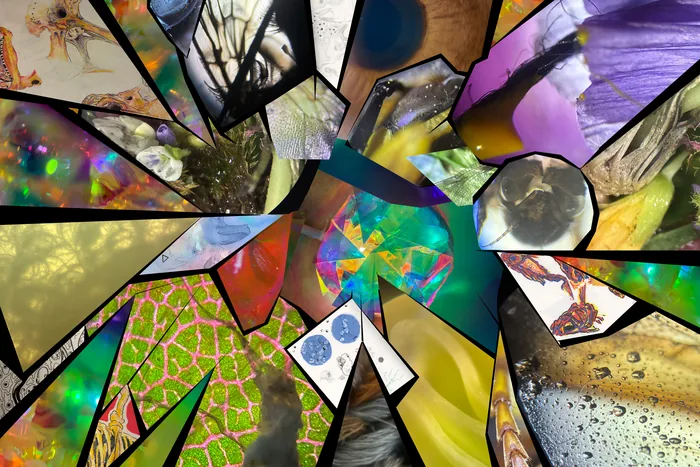
My project explores the connection between what we see every day and what is hidden beneath the surface. Each piece pairs a familiar photograph with a microscopic view of the same subject. Rather than showing both images at once, I invite the viewers to physically move around the work to discover another perspective. Just as I had to change my perspective by looking through a microscope, viewers change their own perspective by walking around the artwork.
Aaron Ames
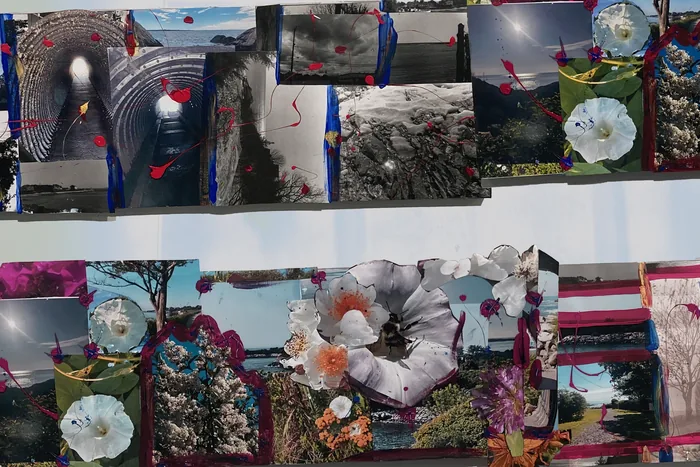
Growing up in Newport I was exposed to so much life and color every summer and then, the harsh gray tones of winter. The balance of the two was so hard to grasp until I paired my black and white photos with color photos. They complimented one another so well; the black and white exposures being the harder of the two images. The color images immediately soften and bring light and life to the total image the viewer is seeing.
The collage ‘51 Summers’ is a representation of my favorite place in the world, an overlooked spot because most people come to the Island for other reasons. I have made this place my home every summer since my earliest childhood memories. I have always wanted to showcase this place to give a local's view of a tourist destination that offers so much more than is usually seen. This is my homage to my hometown's beauty that I hope the tourists never find.
Arnold Falcon
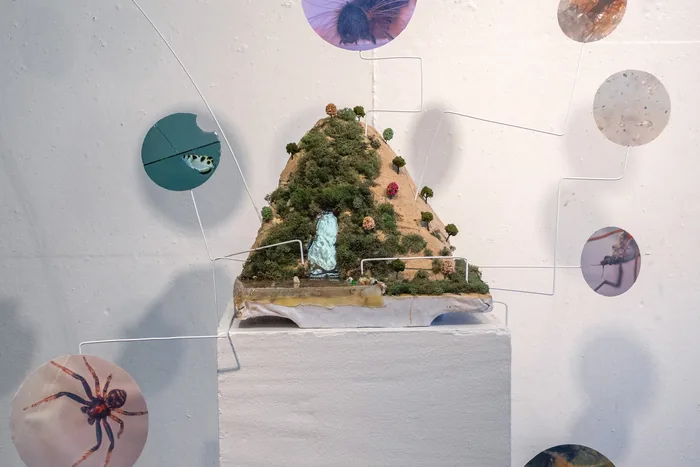
The sculpture ‘Mountain Ecosystem Hidden World’ examines the details of a mountainous landscape with a waterfall, rocks, plants, pond, and fish. The circular pieces which adorn the sculpture are views through a microscope. When viewed closely, ordinary rocks become colorful and complex with their crystals and texture. One stone, a geological miracle, resembles a marble steak. Rich colors and white mineral layers perfectly imitate the texture of muscle and fat. This work was made with foam, moss, resin, stones, small trees, shells, microscope images, and mixed media. My intention is to get people to pause and see things that are not usually noticed. No matter whether we view a mountain from afar or a pebble through a microscope, there is always something interesting to discover about nature.
Elwood Crosby
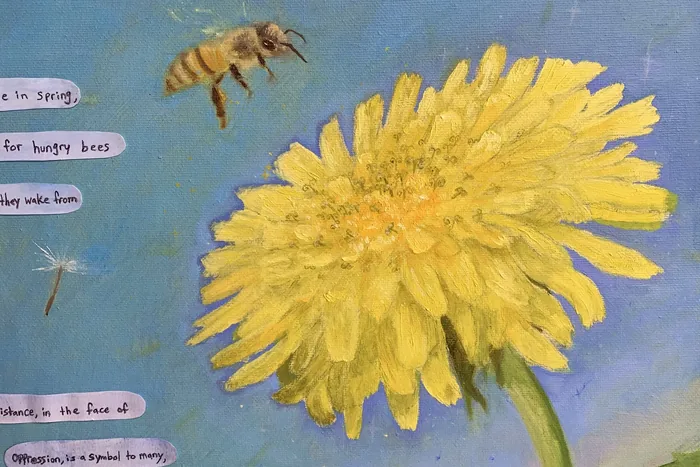
‘Prisms of the Dandelion’ is a piece that goes against what we are told to believe about the dandelion plant. It works as an educational, symbolic and eye opening piece that critiques the unnecessary treatment weed killer companies enforce on such beneficial herbs. The collage style of the painting part is a stylistic choice to make it feel more natural and authentic. The plastic interactive covering is very geometric with clean color and shapes to mimic the corporate design of common weed killing ads. The imagery of the target on the dandelion is a reference to a real commercial for Kiwicare weed weapon. I wanted to feature this to show how strangely violent these commercials can be. In contrast, I made the painting softer; and wrote a loving poem that integrates facts about the dandelion, rather than a facts sheet like I originally intended to put. The poem consists of three parts, one that talks about the medicinal uses of the plant, the second is about it’s impact on the environment, and the third is talking about the cultural symbolism for the queer community, which is right next to a subtle transgender flag that appears in the sky background and a shimmer of rainbow. The hanging string and paper leaves of this piece that peak out from under the plastic ad, is a representation of how persistent and strong dandelions are.
Grace Bautista Dygert
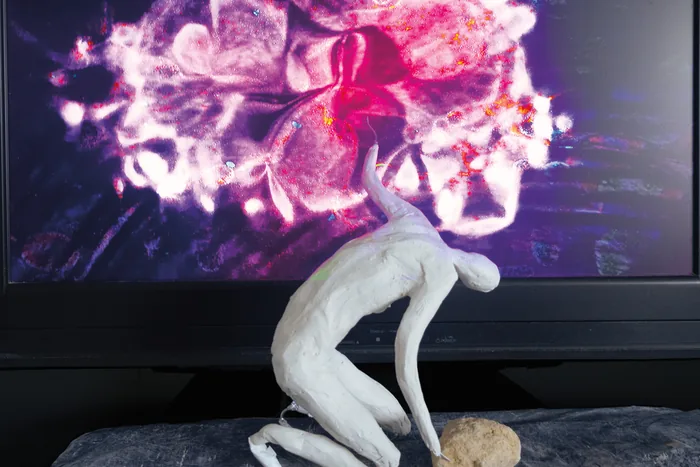
The focus of this piece, ‘Return to the Universe’, is that of a woman whose body is failing. She holds no more physical energy, yet there is still so much to be done. The amount of creative potential within her surpasses her physical stamina, creative energy bursting at the seams of a body that cannot keep up with such a force. In one final powerful effort, she streamlines this creative energy out of her body, back out into the universe. The colorful visuals presented are derived from micro CT scans of juvenile sea urchins, as well as the scan of a sea star under a confocal microscope.
Gale Cabral
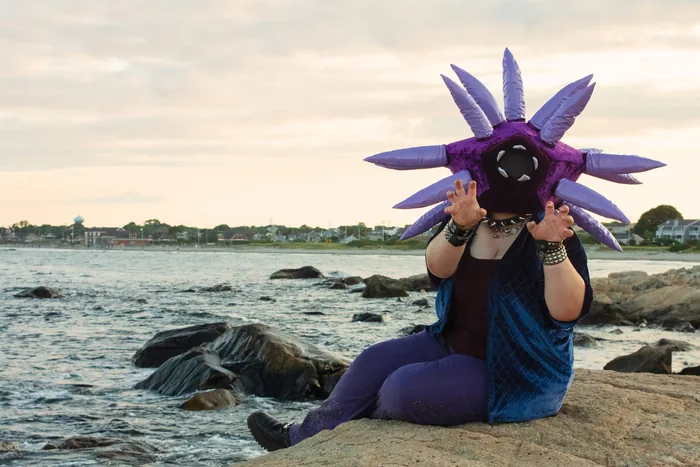
This program gave me the opportunity to study and observe purple sea urchins up close and personal. I was enchanted by these creatures and wanted to recreate that experience for the audience. To take something so small and detailed and scale it up to really appreciate and highlight how cool and intricate they are!
Priscila Maignan
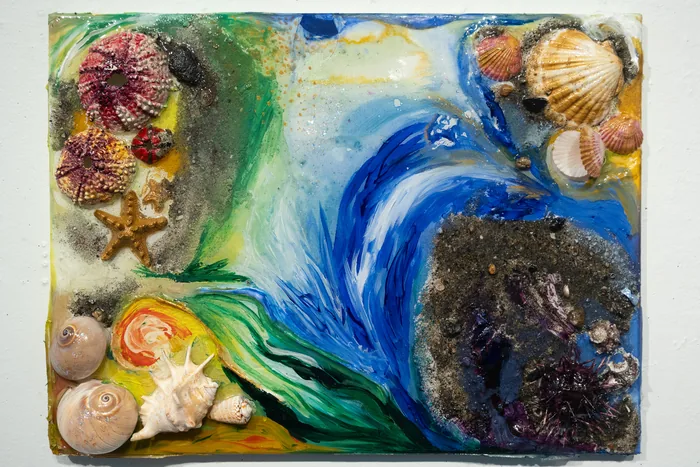
As a student of the sciences, my clinical eye for detail and my artistic vision have become completely inseparable. Where a scientist might see marine specimens as pure data, I see living sculptures. I am deeply captivated by the complex symmetry, tactile textures, and vibrant biological landscapes that exist just beneath the ocean’s surface. My artwork titled ‘Stratum of the Sea’ serves as a physical, three-dimensional bridge between traditional canvas painting and the tangible reality of marine biology. Rather than simply painting an interpretation of the ocean, I have integrated 3D real-life marine creatures directly into the landscape— including the spiked armor of a sea urchin, the perfect spiral of a gastropod shell, and the rough, calcified geometry of a starfish.
Rook Zoglio
I love a good surprise. And I find that if I approach the mundane day to day with a sense of curiosity, I see them everywhere. A cool bug. An interesting rock. A particularly fluffy cloud. With my work, I've attempted to showcase that when I focus on gentleness and patience, the world becomes a place full of little hidden things to discover.
Sam Kukulka
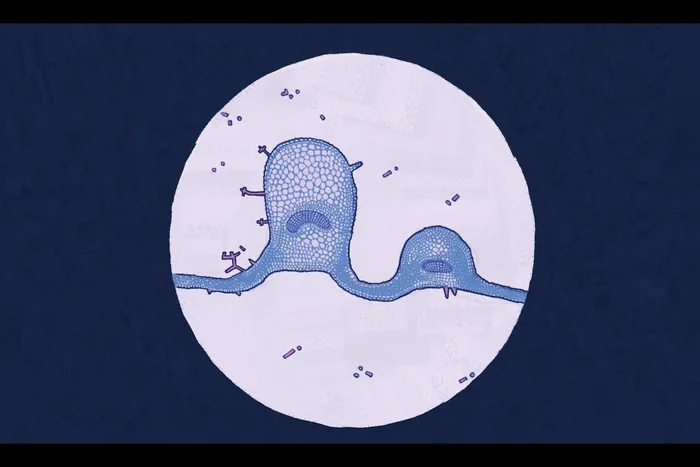
In this modern age of technology, it’s clear that our deteriorating attention spans are becoming an obstacle for us to stop and admire the amazing beauty that nature has to offer. This is what inspired me to showcase these hidden beauties that many don’t even think about. In my animation, we see microscopic views of a pollen, a leaf skeleton and vein, and a pinecone.
Zoe Walsh
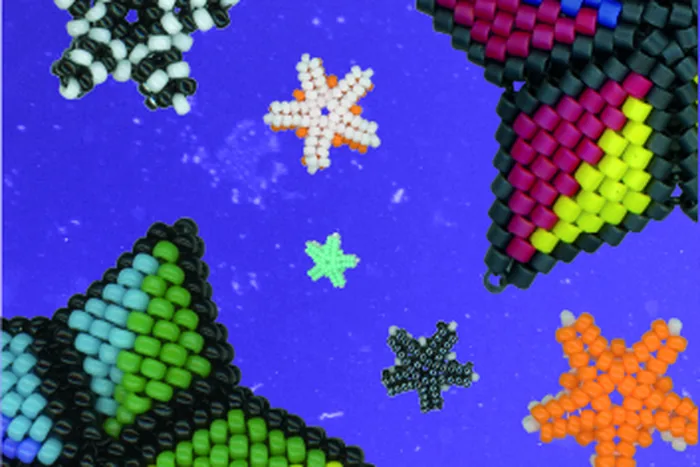
Getting to personally interact with sea star specimens at Wessel Lab inspired me to recreate the beauty of these marvelous, underappreciated creatures with bead work. Just like the forgotten ways in which we used to create all fabrics, jewelry, and decorations, these seemingly simple creatures are overlooked and undervalued. The extremely time consuming and intricate process of creating bead work makes me think of how each living thing comprises trillions of cells. While my pieces thankfully do not consist of so many beads, it really does make one admire the complexities of nature. After collecting the materials needed, creating a pattern, and harnessing the power of my own two hands, I was able to replicate the beautiful details of my starry specimens. Each star is made up of five warped squares that will naturally bend into an arrowlike shape as you add more beads to each row.
Bradyn Guilmette
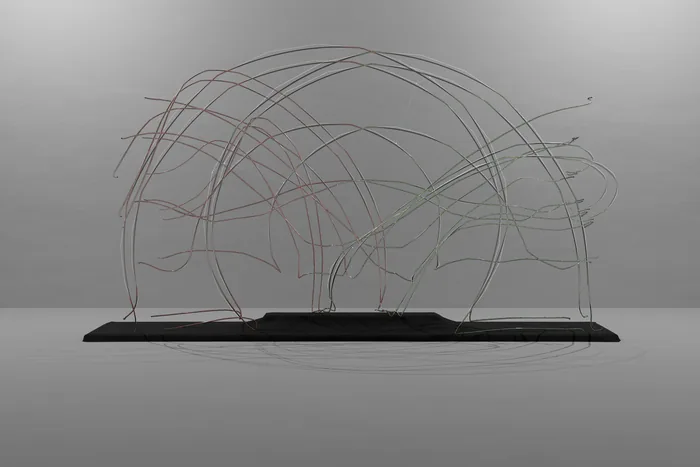
The intricacies of movement have been historically difficult to perceive. This is a prototype for a potential expression of motion. Each curve represents a point on a body tracked through a motion using 3d software, then recreated using a series of suspended wires. The final product is a way to observe motion delivered in such a way to appear vague and complicated, even if the motion is simple.
Emily Houle
...pending...