Science Art Mentorship
Partners
Wessel Lab
Wessel lab uses a variety of organisms and experimental approaches to understand how reproduction works. Wessel lab seeks to understand reproduction through the examination of diverse organisms and to leverage their differences to highlight underlying principles. During 2026 workshops at Wessel Lab, program mentees were immersed in lab imaging processes. Mentees worked with the confocal microscope to view the structure of urchin spines, learned to fertilize sea urchin eggs and observe and document embryo development with a compound microscope, and documented sea star locomotion with macro videography. Several mentees returned to the lab for a follow up visit as they pursued their individual projects.
Tingle Lab
The Tingle Lab’s research focuses on the evolution of snake locomotor diversity and associated morphology. The team includes a broad range of experience, including biology, engineering, design. During 2026 workshops at Tingle Lab, program mentees engaged with the physical form of snakes through specimens, images, and video. Several mentees returned to the lab for a follow up visit as they pursued their individual projects.
Nature Lab, Rhode Island School of Design
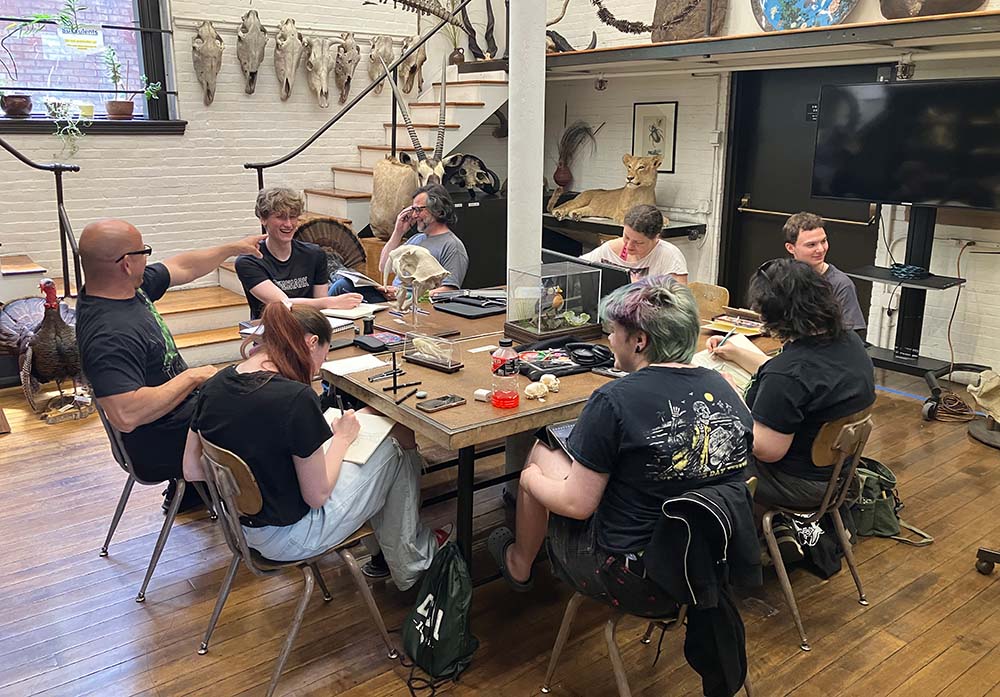
The Nature Lab offers unmediated access to authentic natural history specimens, while fostering creative inquiry into biodesign, ecology, and the climate crisis. In 2025 Mentorship Program, mentees underwent training in microscopy and imaging techniques at the Nature Lab. Mentees made multiple return visits to make use of the Nature Lab’s extensive collections and equipment to further their individual research projects.
Dr. Jason Ramsay
Dr. Ramsay is assistant professor of Biology at Rhode Island College. His lab studies the anatomy and biomechanics of structures used by animals to capture and consume their food/prey. He focuses on how the shapes of jaws, teeth and muscles influence their performance, how those shapes may have arose evolutionary, and how that knowledge may be applied to advances in engineering, medicine, and product design. Dr. Ramsay is a trained illustrator as well as a biologist, and most of the students in his lab have art and science backgrounds. Dr.Ramsay and his students learn the shapes of the animals they work with by illustrating them using traditional and digital media. In 2026, Dr. Ramsay led a full-day biology-based character design workshop to the CCRI mentees and Brown University science students. The workshop began with a review of real-world biological constraints and physical laws that determine animal form and function. Students then audited existing pop-culture character designs, culminating in a challenge for everyone to create and share an original, scientifically believable, fictional creature.
Alex Hornstein
Alex Hornstein is an inventor, photographer and educator with a background in electrical engineering and computer science. Alex has worked as a serial entrepreneur, starting six companies based on inventions that he and his colleagues create. Alex runs an independent invention lab that works on many inventions in parallel, ranging from public health to clean tech power grids to filming wildlife. Alex shared the process of invention and selling several of his inventions, with an emphasis on the importance of working within communities of makers and creative people. Alex demonstrated prototypes and finished examples of inventions including interactive holograms, scopes, and super affordable micro lenses for smart phones.
Hannah Liongoren
Hannah is a designer and artist whose work focuses on interactive exhibits, adaptive reuse, and cultural heritage. Hannah led the final critique for the 2025 Mentorship Program, offering constructive feedback which students acted on as they finalized and installed their projects for exhibition.
Dr. Beatrice Steinert
Dr. Steinert is a Provost's STEM Postdoctoral Fellow at Brown University. Her dissertation explores the common visual histories and practices of art and science through multiple entry points. Her historically-oriented work demonstrates the ways organismal morphogenesis has been theorized through visual making—drawing, animation, film, and model-making—from the late-19th through the mid-20th century. Primarily through filmmaking and exhibition design, she seeks to demonstrate the potential of sensorial, multi-media research for crafting feminist science studies scholarship. In the lab she uses a variety of microscopy and computational imaging techniques to understand the architecture of early-stage embryogenesis in a species of marine crustacean. Dr. Steinert led workshops for mentees at Wessel Lab and participated in final critiques of the 2026 Mentorship Program, providing key insights from her extensive knowledge of the history of art processes in science research.
Jill Nash
Graduate student in Biological Illustration, Rhode Island College
Brandon You
Undergraduate student studying Ecology, Brown University
Sabine Moritz
Science Advisor, Associate Professor of Biology, CCRI
Tyler Vouros
Art Advisor, Associate Professor of Art, CCRI
Lids Bierenday
Art Advisor, Adjunct Professor of Art, CCRI
Daniel O’Neill
Program Director, Associate Professor and Chair of the Department of Art, Art History and Design, CCRI