Inside CCRI’s NECHE Non-Credit Evaluation: A Conversation with Lauren Webb
07/09/2026
WARWICK, R.I. – When the New England Commission of Higher Education (NECHE) visiting team came to CCRI this spring to evaluate the college’s noncredit workforce programs, it marked an important milestone in CCRI’s ongoing work to create stronger connections between education, workforce training, and meaningful career opportunities for Rhode Islanders.
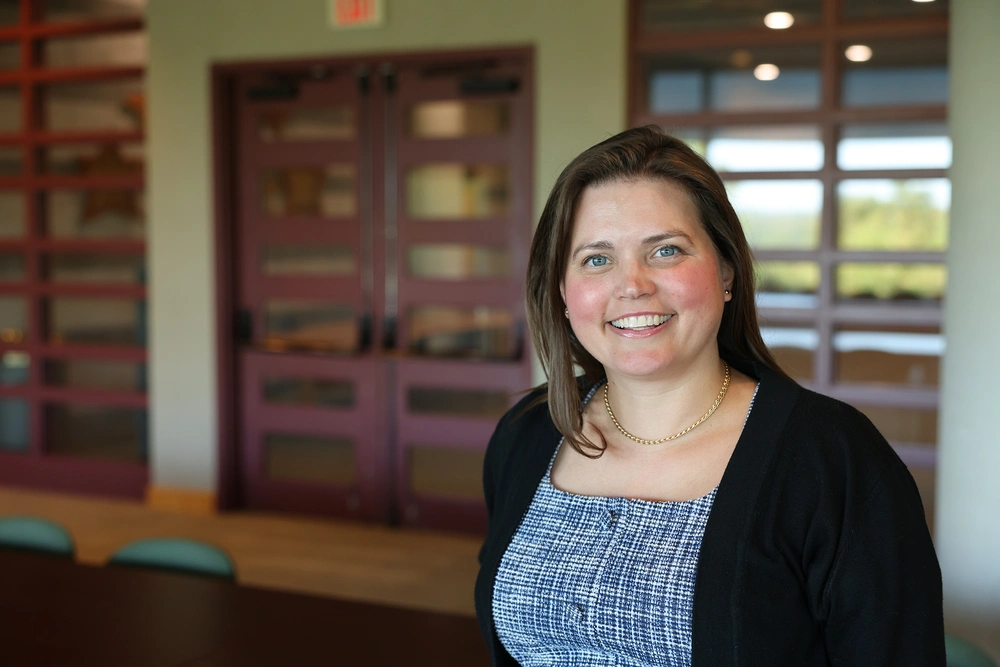
Helping lead CCRI through the extensive self-study and evaluation process was Lauren Webb, whose work brought together colleagues from across the college to demonstrate the strength, quality, and impact of CCRI’s workforce programs. The visiting team’s positive feedback highlighted many of the areas that have become central to the college’s workforce strategy, including strong employer partnerships, pathways between workforce and academic programs, the use of data to drive continuous improvement, and the college’s willingness to innovate and pilot new approaches.
In this edition of Thinkers, Doers & Achievers, Knight Knowledge spoke with Webb about the NECHE evaluation process, what the visiting team’s feedback says about the work taking place across CCRI, and what it could mean for the future of workforce education at the college.
Knight Knowledge: Tell us a little about your journey to CCRI and the work you do at the college. What brought you to CCRI, and how has your role evolved since you arrived?
Webb: I came to CCRI in 2017 after completing a PhD in sociology at Northeastern University in Boston. Throughout my college career and early work life, I had a variety of experiences that pointed me in the direction of a career in higher education administration. I led new student orientation and was a co-captain of a Division III swim team during undergrad, served as the graduate student representative on Northeastern’s faculty senate, and worked with colleges and universities grappling with the expansion of online learning at a higher education consulting firm. I love working as part of a team to solve problems in higher education because what we do is so important.
My first role at CCRI was in standing up the Pathways in Technology Early College program. It’s so gratifying to see how dual enrollment has flourished at the college since then. After some time in the Division of Business, Science, Technology, and Mathematics dean’s office and the birth of my son (who is now almost eight!), I’ve overseen academic assessment and accreditation at the college since 2019. I love that I get to work closely with faculty around student learning assessment and broadly across the college to include everyone in the accreditation process.
Knight Knowledge: CCRI recently completed a NECHE evaluation of its noncredit workforce programs. Can you tell us a little about the evaluation process, why the college undertook it, and what it means for CCRI and our students?
Webb: For four months, a team of Workforce Partnerships directors and staff, led by Jaime Nash, met with me to write a self-study on how our workforce programs meet the ten markers of quality and seven markers of organizational commitment that reflect a culture of continuous improvement. The Workforce team wrote and collected evidence on how we design relevant programs aligned with employment and credit-bearing pathways, respond quickly to industry needs, provide robust student support, employ excellent faculty, achieve strong student outcomes, and maintain the resources and processes necessary to offer high-quality programs.
On June 22-23, a visiting team of leaders in Workforce Development programs from peer community colleges came to CCRI and met with students, faculty, staff, and employer partners to verify the information in our report. The college undertook this process because of President Costigan’s dedication to excellence and our college’s culture of improvement. Just as we ask our students to reflect on their learning and incorporate feedback into their work, whenever we undergo a reflective process, we come away with valuable knowledge that helps us improve how we serve students. The evaluation also provides external validation that CCRI’s workforce programs meet recognized standards for quality and continuous improvement, which is very important as the federal government expands Pell grant funding to short-term workforce programs.
Knight Knowledge: The NECHE visiting team shared very positive feedback following its evaluation. What stood out most to you about the team’s observations, and what did they validate about the work taking place at CCRI?
Webb: One of the highlights the team mentioned in their exit meeting was how impressed they were with our goals for Project Connect to give students a seamless experience regardless of the program they enter. I know it’s not easy work integrating the student experience across the college, but it was validating to hear their encouragement. The main feedback that made me feel so proud to be a part of CCRI, however, was on the strength and depth of our employer partnerships. It’s a real testament to the commitment and service of the whole Workforce Partnerships team and CCRI employees across the college necessary to be a trusted partner to Rhode Island employers. I had the privilege of sitting in on the employer breakfast, and I was struck by the way employers spoke about how CCRI listens to their needs, works tirelessly to develop programs, and is open to feedback and change to ensure that our students graduate with the skills they need to succeed. I’m so excited about all the ways we’ll be able to extend our impact with the prospect of the bond to build the Workforce Innovation Center on the ballot this fall.
Knight Knowledge: The evaluators highlighted CCRI’s pathways between workforce and academic programs. Why is that connection so important, and how does it benefit students who may begin in a workforce training program and later pursue a degree?
Webb: The connection between workforce and academic programs is so important because it reflects the real lives of our students and how they learn. Beyond the importance of offering flexible programs that allow students to combine work, care, and learning, we know that the learning process is more successful when students have a foundation of prior knowledge from their past work and life experiences, and they are able to use that knowledge to make connections with new knowledge and skills. When students see directly how what they are learning supports their future goals, they’re more motivated and engaged. They are better able to apply their skills and knowledge in careers that meet the evolving needs of employers and society.
For instance, a student could attend the Fit2Serve Pathway to Policing program to prepare for a career in law enforcement, get assistance being hired by a municipal police department, and receive Criminal Justice prior learning credit for training already completed, tuition benefits, and a pay increase upon completion of the associate degree — what a great opportunity for students and their families.
Knight Knowledge: What do you find most rewarding about your work at CCRI, and what makes you most excited about the college’s future?
Webb: I wake up motivated every day by our mission at CCRI (and not just because I was a co-chair of the committee that updated our mission statement!). It’s meaningful to serve our students, support faculty, and contribute to an institution that’s vital to democracy and human flourishing. Just as importantly, I love working side by side with such smart, driven, and fun colleagues. I’m excited about how our work to strengthen basic literacy, prepare students for careers with family-sustaining wages, and develop the thinking skills necessary for citizenship and lifelong learning has a direct, positive impact on Rhode Island and our world. The NECHE noncredit recognition process affirmed how much progress CCRI has made, and it also gives us momentum to continue to build innovative pathways that help Rhode Islanders learn and grow.
Have something to share?
Submit a StoryHave a story about a student, colleague, or yourself?! Share your story with CCRI and engage with the community.