How Dan O'Neill Helps CCRI Students Translate STEM Research Into Visual Art
09/03/2026
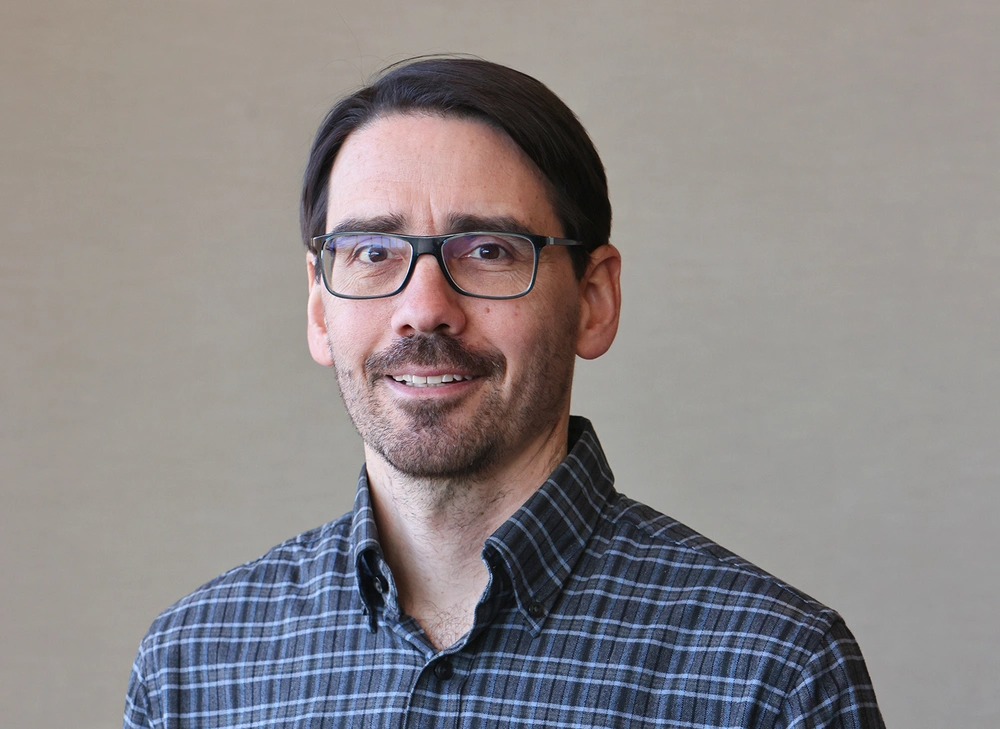
WARWICK, R.I. – Dan O’Neill built his career by merging artistic expression with the natural world, working in commercial photography, exhibit design at the Bronx Zoo, and fabrication for renowned studio artists. Today, as Chair of the Community College of Rhode Island’s Art, Art History & Design department, he brings that multidisciplinary experience directly to the classroom.
He is also the driving force behind CCRI’s Science Art Mentorship Program. Now in its second year, the paid summer initiative recently partnered with Brown University research labs to help art students translate complex STEM data into creative visual media. The students' work is currently on display in the “Prismosities” exhibition, which runs until Sept. 30 at the Lincoln Campus. Beyond these specialized mentorships, O'Neill continues to adapt his curriculum to a changing digital landscape, ensuring his foundational art courses remain rooted in human creativity despite the rise of artificial intelligence.
In this edition of Thinkers, Doers and Achievers, Knight Knowledge spoke with O’Neill to learn more about his career, the “Prismosities” exhibition, how AI is impacting art in the classroom, and more.
Knight Knowledge: First, can you tell us a bit about your background and what brought you to CCRI?
O’Neill: I grew up in Providence. I was always interested in both science and art. I liked drawing animals and being outside. I wanted to study both science and art in college but ended up focusing on art. After college, I worked as a commercial photographer and illustrator, as an exhibit designer at the Bronx Zoo, and in the studios of artists who were successful enough to employ people: Howard Ben Tre, Joseph Kosuth, Ursula von Rydingsvard. I exhibited my own artwork throughout this time.
Becoming a professor was a career goal. Teaching in a program that focuses on Foundation, rather than specializing in a specific medium, made sense to me. In my different jobs, I had picked up various fabrication and graphics skills and experienced many ways that professionals plan and implement creative projects. In Art and Design school, teaching Foundation means teaching in the first year. Foundation focuses on design principles, design process (including experimentation and building prototypes), and forming community with peers through collaboration and critique. Once I got to CCRI, the talent and motivation of the students here inspired me to shape my career around our students: Rhode Islanders who want to work as artists and designers.
Knight Knowledge: The Science Art Mentorship Program has been a great success and now is completing its second year. What originally inspired you to create the program, and what makes it such a unique opportunity for students?
O’Neill: I was inspired by a program at Rhode Island School of Design called Vis-a-thon. Vis-a-thon is a collaborative program that pairs regional STEM researchers with RISD graduate student artists to explore art-based approaches to science visualization. Vis-a-thon is a fast-paced program—most of the activity happens over a few weekends. For CCRI, I wanted to create a version focused on mentoring students in their first few years of college. Our program includes a lot of time with students. This summer we met in person for nine weeks, two full days each week. That is more contact hours than taking two in-person, 15-week classes. There is a lot of time with our mentors—scientists, inventors, artists, and professors—and a lot of time the students spend with each other. We are not in a rush, and the students get paid for their time. Our trips to the research labs at Brown are full days, with a lunch break. We have full-day workshops at CCRI, in the biology lab classroom, walking in the woods to observe and collect specimens, and in the art and design studios.
Four times over the program, we gather for presentations. Each student presents their experience and progress to the rest of the group. The resulting discussions are vital for the group. Students get to practice articulating to each other what they are doing and why. In a productive studio art environment, the students learn more from each other than from their teachers. When a group of people openly communicate with each other about their goals and struggles and achievements, they can accomplish anything. Teamwork, communication, problem solving—these are three of the most useful skills someone can learn, applicable in any professional situation.
Knight Knowledge: What were some of the biggest differences in the second year of the program compared to the first?
O’Neill: Adding the collaboration with two Brown University labs was the major improvement we made this year. The collaboration is based on the idea that these labs use art and design processes in their research. That can be an entry point for students who are not scientists. When I walk into a science research lab, I see art and design processes everywhere. Microscopes take photos and videos, and the lighting and composition must be right for those photos and video to be useful data. Photos must be arranged and presented in a way that conveys a message. There are three-dimensional models, both digital and physical. Each of these models is a summarized, abstracted version of a complex organism. People must decide which details to include in the model, and what to leave out. People must decide how to construct and represent the organism in specific three-dimensional materials. Diagrams and illustrations are everywhere in a lab, and creating these involves similar decisions. Art made with a person’s hands can have its own attractive power—knowing that a person made this object or drawing, and there are intuitions and subconscious drives behind it.
Within all those art and design decisions, there is opportunity for artists and designers to contribute. Creative audio can be added to silent microscope video of cells dividing. The audio can act as arrows do in a diagram, indicating significant events in a process. A three-dimensional model of a sea urchin can be made at human scale as a wearable mask, helping people understand what it would be like to be a sea urchin. Sketches made in the lab can help people understand the process or detail of an organism.
Gary Wessel at Wessel Lab, Jessica Tingle at Tingle Lab, and everyone who works with them, were incredibly generous in devoting their expertise and resources to designing and implementing workshops for us at their labs. The experiences in the labs fueled the CCRI students’ creative projects and shaped the program’s final exhibition.
Knight Knowledge: What can people expect when they visit the exhibition in Lincoln?
O’Neill: Visitors will see twelve distinct artistic voices, responding to this summer’s immersive experience in science research and the natural world. To describe a few of the artworks: a painting celebrating the dandelion life cycle, wearable sea urchin character design, a model of a mountain stream environment, photography installations about scale and memory, a wire sculpture based on animated motion paths, and marine life recreated in intricate beadwork. The exhibition is open weekdays, 10 a.m. to 4 p.m. until Sept. 30, with a public reception on Friday, Sept. 11, from 4 to 7 p.m.
Knight Knowledge: Artificial Intelligence has shaken up the art industry in significant ways, with more change on the horizon. In your teaching, how do you balance the presence of AI while keeping the focus on human creativity?
O’Neill: I keep the focus on human creativity. I mostly teach two digital media courses, Digital Art and Video Art, and our capstone course Fine Arts Seminar. AI is built into Photoshop and the other graphics programs we use to make processes like image selection faster. In that sense we are using AI, every day. But I have not built any assignments specifically around AI.
I focus on creating a classroom environment in which people are making and sharing their progress and ideas with each other. I believe that everyone is self-taught. I show students what I know, but to learn, a person must experiment with the material on their own, grapple with it, and come to their own understanding and experience of it. At the foundation level, there is a lot to learn about design principles, effective use of materials, and how work is perceived by an audience. We follow a design process, and it is important that students are intentional and able to shape all steps of the process on their own without AI.
Have something to share?
Submit a StoryHave a story about a student, colleague, or yourself?! Share your story with CCRI and engage with the community.