How Art Professor Andrew Goodman Has Designed Memorable Career At CCRI
05/27/2026
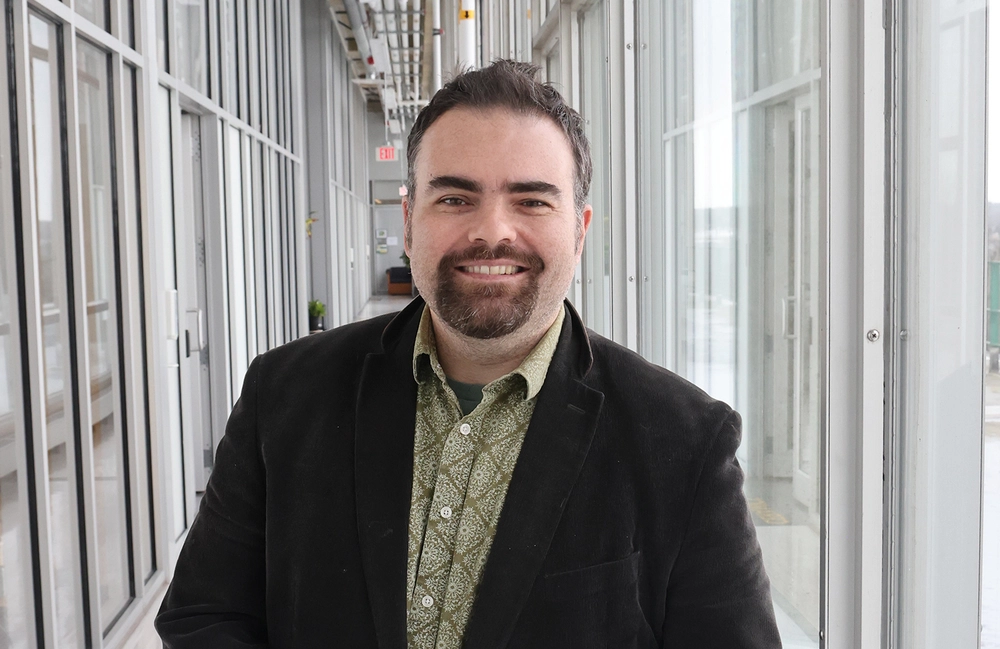
WARWICK, R.I. – Andrew Goodman knew he wanted to teach art the moment he took his first college design class. Decades later, as a Professor of Digital Art and Design at the Community College of Rhode Island, he is helping his own students experience that same sense of discovery.
After teaching at Brown University and RISD, Goodman returned to the Ocean State to join CCRI, drawn by the tight-knit faculty and a student body that continually inspires him. His creative work even made its way onto the state's highways recently, as he is the artist behind Rhode Island’s new Commercial Fisheries Research Foundation license plate.
These days, Goodman's impact stretches across the college. He just wrapped up a pivotal tenure as co-chair of CCRI’s AI working group, where he helped the administration and faculty navigate the massive technological shifts reshaping higher education. Now, he is stepping up as the new president of the Faculty Senate, bringing with him a plan to streamline the group's operations and create more direct, casual spaces for faculty voices to be heard.
In this edition of Thinkers, Doers & Achievers, Knight Knowledge spoke with Professor Goodman to learn more about his career, his thoughts on artificial intelligence, and more.
Knight Knowledge: You’ve built your career at CCRI as a professor of Digital Art and Design. What first brought you to the college, and what has kept you here over the years?
Goodman: I knew I wanted to be an art professor since I took my first art class my junior year of college. I had always been interested in art and design but never thought I could make a career out of it until I stepped into the classroom. That’s what set me on the path, but what ultimately brought me to CCRI was how much I loved (and missed) Rhode Island. When I applied, I had been living in Boise, Idaho, for two years, but before that I had lived in Rhode Island for many years and still had a lot of friends living here. CCRI was a chance to “come home” and do the work that I’d been dreaming of doing for decades.
As for what has kept me here, it's my colleagues. I’ve worked in higher education since 2009, and the Department of Art, Art History, and Design is hands down the best academic department I’ve ever worked with. I genuinely love spending time with my colleagues. They bring the best version of themselves into the classroom and they inspire me to do the same.
Knight Knowledge: What do you value most about teaching at CCRI?
Goodman: It's all about the students. I worked at Brown for most of a decade and was an adjunct at RISD for many years, and while there were many talented students at both schools, I never felt the sense of wonder that I do here. I have had students tell me that they never thought of themselves as artists or designers before taking my classes, and to know that I helped to open that door for my students is a really profound feeling.
Knight Knowledge: Beyond the classroom, you designed RI’s license plate benefiting the Commercial Fisheries Research Foundation. How did you get involved with that project and how do projects like that connect to your work as an educator and artist?
Goodman: In true Rhode Island fashion, the CFRF license plate project came about because I “knew a guy”...or more accurately, I knew a gal. Back in 2021-2022, the state had a competition to replace the old wave license plate, and I put together a design featuring local sea shells. I ended up sharing my design with my friend Sarah Schuman (Sarah is an amazing human being who founded Eating with the Ecosystem, has written a cookbook and another book on the history of shellfishing in Rhode Island, and is currently working on fisheries climate resilience). She absolutely loved the design and insisted that it needed to find its way on to the road. She ended up connecting me with the CFRF and the rest is history.
As far as how the project connects to my teaching and practice, I’ve found that it works on a couple of levels. I tell my design students all the time that everything we see in the world, from product packaging and logos to license plates and posters, is designed by someone. Having the opportunity to show them that process in real time, to open up my work files and explain how I actually made the design, is a chance to look behind the curtain, and that’s a tremendous teaching opportunity. The other connection is more philosophical, which is this idea that as an artist and designer, we have opportunities to make an impact on the world around us. It might be creating a single image that hangs on the wall and makes a loved one smile, or it could be creating a logo that brings together a community. The license plate is a wonderful living example of that idea.
Knight Knowledge: In addition to serving as president of the Faculty Senate, you also co-chair CCRI’s AI working group. What do you see as the biggest impact AI will have on higher education and how should colleges respond to it?
Goodman: Wow… I’m pretty sure I could write a book responding to just this one question. The conversation around AI at CCRI started all the way back in the spring of 2023, and I’ve been involved ever since (although it’s worth noting that I’ll be stepping down from my position with the AI-ICC on May 26th). From the very beginning I saw the challenge of AI as having three parts: today’s problems, tomorrow’s problems, and the problems we’ll be dealing with for the rest of our lives.
Today, the biggest challenge is AI being used to emulate knowledge. As an institution dedicated to building real knowledge, this presents some significant challenges. How do we know if an essay, an image, a math problem, or a piece of code was created by a person or an AI? This question seems to get harder with every passing day, and there are no silver bullets (many AI detection tools will flag human-generated content as being produced by AI, and vice-versa). Instead, we need to find creative ways to share and assess knowledge. This could mean returning to oral exams and handwritten “blue book” essays, embracing presentations and group projects, or developing entirely new methods that have yet to be conceived. I’m confident we can meet these challenges, but doing so will mean changing how we teach and assess, and change is never easy.
The problems of tomorrow are harder to anticipate. The only thing I feel confident calling out is the inevitable bursting of the AI bubble. Ironically, I don’t see this as a problem. What I do worry about is that people will see high-profile AI companies (and likely some big-name tech companies too) going under as a sign that AI is dead or “just a fad.” I’m old enough to remember the dot-com bust, and while companies like pets.com and kozmo.com were ridiculed at the time, the services they promised are now our everyday reality (see Chewy and Instacart/Uber). We risk repeating this mistake if we assume that the collapse of OpenAI or Meta means that AI is “dead” and we can go back to the way things were. For better or worse, the AI genie is out of the bottle, and while it may slow down, the changes it promises will find us eventually.
Which brings us to the rest of our lives. AI is such a profound development, and we are so close to it that it is difficult to fully comprehend what lies ahead. There was a time before written language when everything needed to be memorized, and the scholars of that time developed complex techniques for retaining information. With the emergence of writing, those techniques were largely forgotten and scholarship became rooted in literacy rather than memorization. I believe we are facing a similar tectonic shift, and there will be many hard conversations (as an institution, within academia, and as a species) about what needs to be preserved and what needs to change. We can never know the full scope of everything that was lost in the transition to writing, but we can see everything that has come from it: histories, biographies, dictionaries, encyclopedias, holy books, comic books, Facebook, and ChatGPT. If past is prologue, then we are on the precipice of something profound and terrifying. We can only begin to anticipate everything that can go wrong, but we must also be open to all the beauty and wonder that has yet to be imagined.
Knight Knowledge: As you begin your term as president of the Faculty Senate, what are your top priorities and goals for the year ahead?
Goodman: My primary goal for the coming year is to continue the incredible work of my predecessor, Christine Lynch. Under her leadership, the Faculty Senate updated its Constitution and Bylaws and became a more professional and efficient organization in the process. This summer, the Faculty Senate Officers hope to build on last year’s progress by drafting the Senate’s first Standing Rules (the organizing document that outlines the day-to-day operations of the body) and changing the seating configuration for Faculty Senate meetings. I realize neither of these may sound particularly exciting, but (as I tell my students) often it is the simplest details that can have the biggest impact on how we understand and experience something.
Once the academic year gets underway, we’d like to focus on engaging more with the faculty. We will be pushing back the start of our regular monthly meetings to give faculty an opportunity to engage directly with their senators and the administration. Our hope is that these regular 30-minute “coffee hours” will provide more opportunities for conversation and help the Faculty Senate to be more connected to the community we serve. While we are still working on the details, we would also like to host our first Faculty Senate Town Hall with the goal of hearing directly from faculty on where they want to see the Faculty Senate focus its efforts.
Finally, the Faculty Senate exists to serve the faculty, so where we go in the year to come ultimately rests on the priorities and concerns brought to us by our colleagues. I encourage faculty to reach out to their department’s senators with any business they wish to have brought before the Senate, but I will also remind the entire CCRI community that the Faculty Senate’s meetings are open to the public and everyone is free to attend. Shared governance is a collective effort, and we encourage everyone to participate in whatever capacity they are capable of.
Have something to share?
Submit a StoryHave a story about a student, colleague, or yourself?! Share your story with CCRI and engage with the community.