CCRI To Award Inaugural Honorary Degrees To Journalist Dan Barry and the late Judge Frank Caprio
04/06/2026
Warwick, R.I. – For the first time in the institution's history, the Community College of Rhode Island (CCRI) will recognize individuals with honorary degrees at its 2026 Commencement on Tuesday, May 12, 2026, at the Amica Mutual Pavilion.
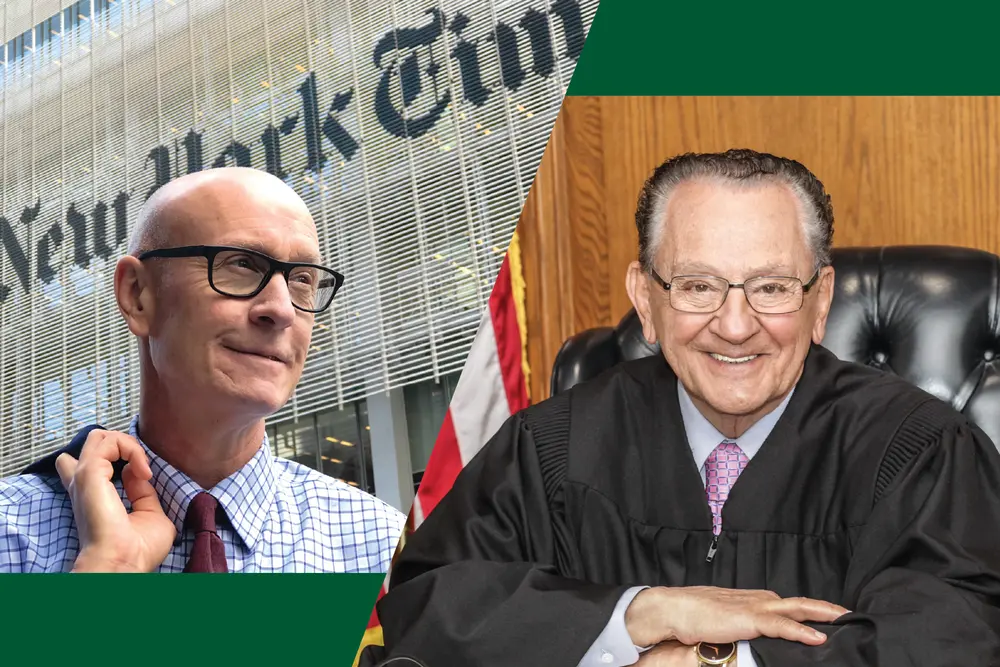
The college will award an Honorary Associate in Arts degree to New York Times Pulitzer Prize-winning journalist and author Dan Barry, in recognition of his extraordinary contributions to journalism and storytelling. CCRI will also award a posthumous Honorary Associate in Arts degree to the Honorable Frank Caprio (1936–2025) in recognition of his lifetime of public service, leadership, and commitment to opportunity and education.
The introduction of honorary degrees marks a new milestone for CCRI, designed to celebrate individuals whose lives and work reflect the college’s mission and values.
"Commencement is a moment to honor not only our graduates, but also those whose impact aligns with our mission and exemplifies what is possible through education, service, and a deep commitment to the common good," said CCRI President Rosemary A. Costigan, Ph.D., RN. "Dan Barry’s remarkable career in journalism and his enduring belief in the power of storytelling make him a perfect choice for one of our inaugural honorary degrees. Similarly, Judge Caprio's profound commitment to expanding educational opportunities and his uniquely compassionate approach to justice serve as an enduring inspiration to our community.”
Barry and Caprio were recommended to the President as the College’s inaugural honorary degree recipients by the college's Honorary Degree Committee — comprised of representatives from Academic Affairs, Student Affairs, the Faculty Senate, the Staff Assembly, and Student Government — following a collegewide nomination and review process. Candidates were evaluated on their professional excellence, character, service, and alignment with CCRI's mission and values. Their nominations were subsequently approved unanimously by the Rhode Island Council on Postsecondary Education
A nationally acclaimed narrative writer, Barry has served as a columnist and long-form specialist for The New York Times since 1995. He previously worked for The Providence Journal, where he was part of the investigative team awarded the 1994 Pulitzer Prize for its coverage of the state's banking crisis.
Barry is also the author of several celebrated books, including Bottom of the 33rd, which tells the story of the historic Pawtucket Red Sox marathon baseball game. The book won the PEN/ESPN Award for Literary Sports Writing. His other works, such as The Boys in the Bunkhouse and This Land: America, Lost and Found, further highlight his dedication to telling uniquely American stories.
Throughout his career, Barry has demonstrated exceptional empathy, intellectual curiosity, and integrity in his reporting. His work consistently highlights the insight and potential present in every individual -- values that resonate deeply with CCRI’s own commitment to empowering its students through education and opportunity.
In addition to receiving an honorary degree, Barry will deliver the Commencement address to the Class of 2026, offering graduates insight drawn from a distinguished career in storytelling and public life.
Judge Caprio devoted his life to public service and to the people of Rhode Island. Born and raised in Providence to Italian immigrant parents, he became the first in his family to graduate from college and earn a law degree -- an achievement realized while working and supporting his family. He served for 38 years on the Providence Municipal Court, earning national and international recognition for his compassionate and humane approach to justice. His courtroom became widely known through the television program Caught in Providence, where his fairness, empathy, and commitment to dignity earned him admiration around the world.
His public service also extended to higher education governance. Judge Caprio served for a decade as Chairman of the Rhode Island Board of Governors for Higher Education, where he helped guide policy and leadership for Rhode Island’s public colleges and universities, including CCRI. A strong advocate for education, Caprio established several scholarships to support students pursuing higher education and community service. His memoir, Compassion in the Court, further reflected his belief that justice should always be guided by humanity and understanding.
Have something to share?
Submit a StoryHave a story about a student, colleague, or yourself?! Share your story with CCRI and engage with the community.