Cybersecurity - Associate in Science

This program may be completed at the Knight (Warwick) Campus or Newport County Campus.
The Cybersecurity program is designed to provide students with a strong foundation in the principles and methods of cybersecurity, as well as the fundamental knowledge and tools for applying security measures across a variety of network architectures and settings. In addition to serving as a strong foundation for pursuing a bachelor's degree in cybersecurity, this associate degree program will provide the educational background and hands-on training necessary to prepare students for entry into the cybersecurity sector. The curriculum includes a combination of general education, computer science, and network technology courses to provide students with the knowledge, skills, and training necessary for a successful transition into a career in security, and to meet National Security Agency (NSA) and Centers of Academic Excellence (CAE) core foundational content and standards.
Note: Students must earn a grade of at least C in all computer course requirements and must maintain a 2.0 GPA. Many courses require prerequisites, corequisites and/or testing. See course descriptions for details.
Program Learning Outcomes
Upon completion of this program, a student will be able to:
- Demonstrate critical thinking and problem-solving skills.
- Explain basic objectives of cybersecurity and the importance of information security as well as the current threats to networks.
- Design, build, and maintain scalable and secured networks using routers, switches, firewalls, network intrusion detection systems, and vulnerability assessment tools.
- Demonstrate proficiency in the use of scripting languages to develop solution algorithms and automate system administration tasks.
- Apply various cryptography concepts including plain-test, cipher-text, symmetric and asymmetric cryptography as well as the techniques for crypto-analysis.
- Assess cybersecurity risk management policies in order to adequately protect an organization's critical information and assets.
- Apply theoretical knowledge, problem-solving skills, and ethical principles to address case studies and practical applications in networking and cybersecurity.
- Demonstrate an understanding of the role and functions of cybersecurity professionals in organizations.
Requirements
| Code | Title | Hours |
|---|---|---|
| General Education Requirements | ||
| ENGL 1010 | Composition I (or ENGL 1010A) | 3 |
| Humanities Elective | Take PHIL 2030 if transferring to Johnson & Wales University Cyber Threat, Intelligence & Defense B.S. Degree | 3 |
| Humanities Elective | 3 | |
| MATH 1139 | Mathematics for Liberal Arts Students (or MATH 1139C) | 3 |
| Social Science Elective | 3 | |
| Social Science Elective | 3 | |
| Choose ONE of the following: | 3-4 | |
| Subtotal | 21-22 | |
| Major Requirements | ||
| CNVT 1810 | Networking 1 | 3 |
| CNVT 1820 | Networking 2 | 3 |
| CNVT 1830 | Networking 3 | 3 |
| CNVT 2200 | Network Security Hardware | 4 |
| COMI 1170 | Scripting for System Administration | 3 |
| COMI 1800 | Computer Networking Software Linux | 3 |
| COMI 2035 | Introduction to Computer Forensics | 3 |
| COMI 2036 | Introduction to Computer Ethics | 3 |
| COMI 2037 | Foundations of Cybersecurity | 3 |
| COMI 2038 | Ethical Hacking | 3 |
| COMP 1200 | Database Design & Management | 3 |
| COMP 2500 | Cybersecurity Practicum/Capstone Course^ (Work-Based Learning Course; requires instructor permission and is recommended in your final semester) | 3 |
| CYBR 1100 | Defending External Threats | 3 |
| Subtotal | 40 | |
| Total Hours | 61-62 | |
Recommended Course Sequence
| Year 1 | ||
|---|---|---|
| Semester 1 | Hours | |
| CNVT 1810 | Networking 1 | 3 |
| COMI 1800 | Computer Networking Software Linux | 3 |
| ENGL 1010 | Composition I (ENGL 1010A) | 3 |
| MATH 1139 | Mathematics for Liberal Arts Students (MATH 1139C) | 3 |
| Choose ONE of the following: | The program requires 6 credits in Humanities Electives and 6 credits in Social Science Electives | 3 |
|
If transferring to Johnson and Wales University, PHIL 2030 must be one of your Humanities Electives
|
||
| Hours | 15 | |
| Semester 2 | ||
| CNVT 1820 | Networking 2 | 3 |
| COMI 2035 | Introduction to Computer Forensics | 3 |
| COMI 2036 | Introduction to Computer Ethics | 3 |
| COMP 1200 | Database Design & Management | 3 |
| Choose ONE of the following: | The program requires 6 credits in Humanities Electives and 6 credits in Social Science Electives 1 | 3 |
|
If transferring to Johnson and Wales University, PHIL 2030 must be one of your Humanities Electives
|
||
| Hours | 15 | |
| Year 2 | ||
| Semester 1 | ||
| CNVT 1830 | Networking 3 | 3 |
| COMI 1170 | Scripting for System Administration | 3 |
| COMI 2037 | Foundations of Cybersecurity | 3 |
| Choose ONE of the following: | The program requires 6 credits in Humanities Electives and 6 credits in Social Science Electives 1 | 3 |
|
If transferring to Johnson and Wales University, PHIL 2030 must be one of your Humanities Electives
|
||
| Choose ONE of the following: | 3-4 | |
| Hours | 15-16 | |
| Semester 2 | ||
| CNVT 2200 | Network Security Hardware | 4 |
| COMI 2038 | Ethical Hacking | 3 |
| COMP 2500 | Cybersecurity Practicum/Capstone Course^ (Work-Based Learning Course) | 3 |
| CYBR 1100 | Defending External Threats | 3 |
| Choose ONE of the following: | The program requires 6 credits in Humanities Electives and 6 credits in Social Science Electives 1 | 3 |
|
If transferring to Johnson and Wales University, PHIL 2030 must be one of your Humanities Electives
|
||
| Hours | 16 | |
| Total Hours | 61-62 | |
Transfer
Please meet with an Academic Advisor/Student Success Coach if you are interested in earning a bachelor's degree. Your Academic Advisor will help you select the courses that best prepare you for transfer to a four-year college or university.
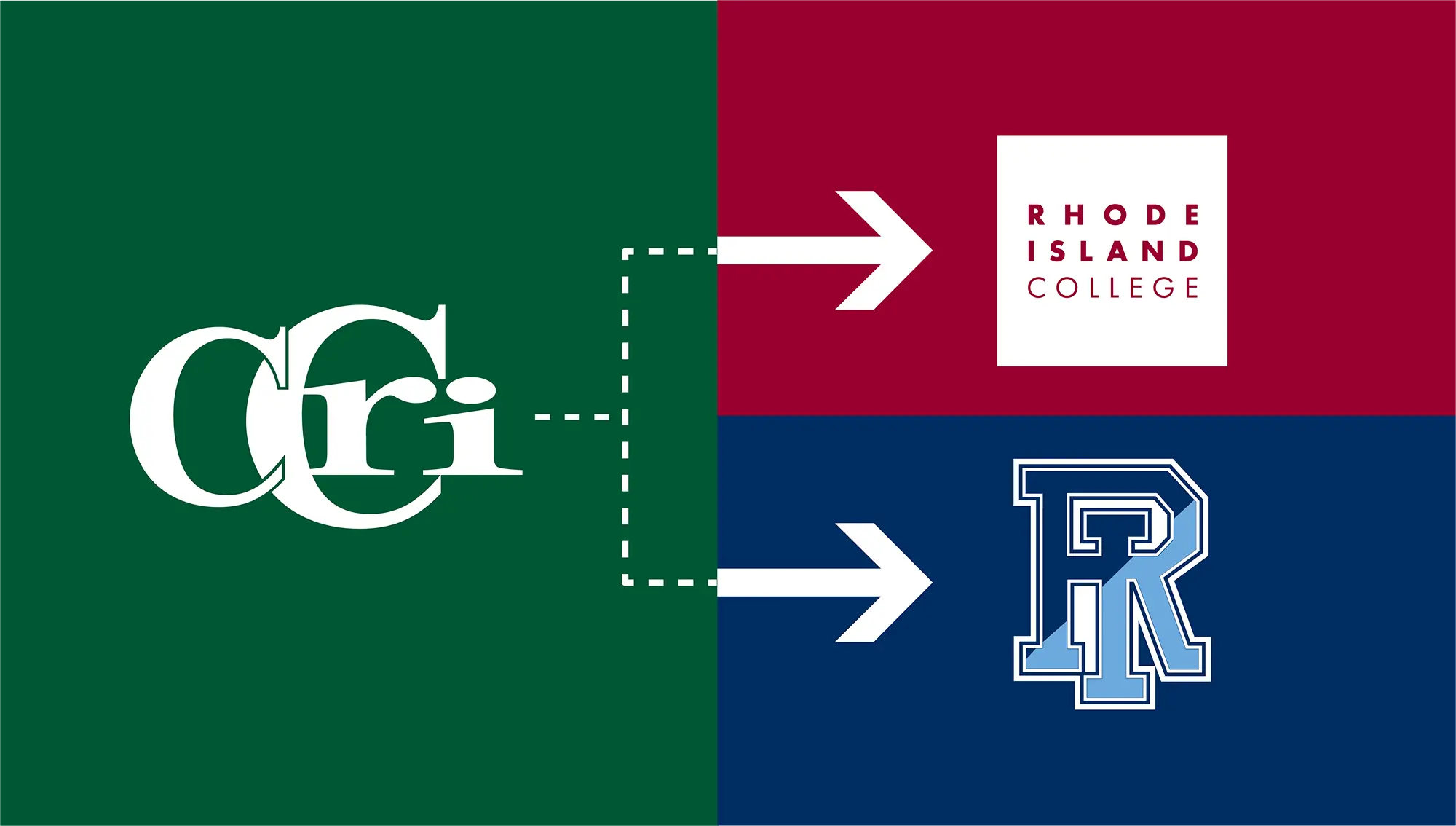
Check out the Joint Admissions Agreement if you are interested in transferring to Rhode Island College or the University of Rhode Island. The JAA program offers seamless transfer to RIC or URI with additional benefits. Transfer information, events, and articulations are available on the Transfer Center website.
Where Opportunity Meets Affordability
Why Choose CCRI?
CCRI, one of New England's most affordable colleges, is now completely free for Rhode Island students heading straight from high school thanks to the Rhode Island Promise Scholarship. For those pursuing a bachelor's degree, starting at CCRI can also lead to up to 30% discounted tuition at Rhode Island College or the University of Rhode Island upon transferring.

Our Services
We Are Here for You!
CCRI puts your success at the center of all we do. Staff from our Advising and Counseling, The Tutoring Center, Career Services, Benefits Hub, Financial Aid, Veteran Services, and the entire Division of Student Services is here every step of the way to help you reach your academic and career goals.
At One Stop we assist prospective, current, and former students, with a variety of processes including applying to college, checking financial aid status, turning in required documents, registering for classes, paying your bill, and more!
The Advising Center offers a full range of services for CCRI students. These services include academic advising, career, educational and personal counseling services.
CCRI's Tutoring Center provides free in-person and online tutoring and academic coaching to help you achieve success.
Career Services collaborates with and prepares our diverse student population to make well-informed career decisions through professional readiness, exploration, and work-based learning opportunities.
The Benefits Hub offers students basic needs assistance grounded in respect, trust, and equity.
CCRI offers financial assistance to students who might otherwise be unable to further their education without such support. The Financial Aid Department is here to guide you through the process.
The CCRI Veteran Services Office is committed to being a resource to all VA education beneficiaries.

Where Campus Life Comes to Life!
Beyond the Classroom
CCRI offers a vibrant campus life with a variety of events, athletic programs, and student clubs to keep you engaged and connected throughout your college experience.
Related Resources
Welcome to CCRI
Apply for Free Today!We're excited about your interest in attending the Community College of Rhode Island! Whether you're looking to discover your career path, start or complete your college degree, or take classes to enrich your life, we look forward to having you join our community!